

The Broken Window Theory
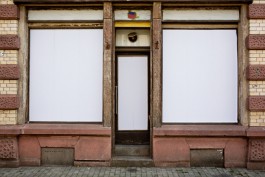
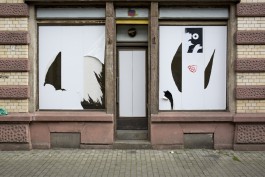
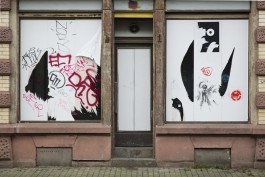
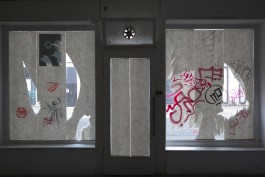
Windows and doors papered from the outside. After two months, the wallpaper was scratched, sprayed and partially torn off.
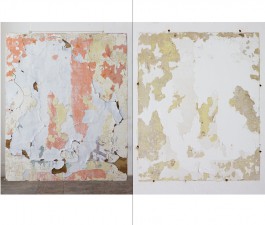
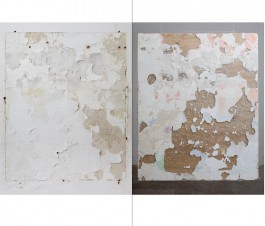
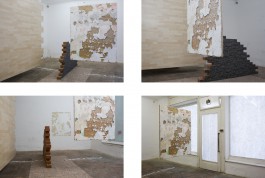
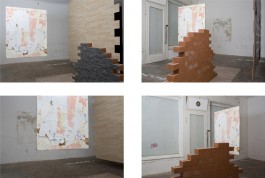
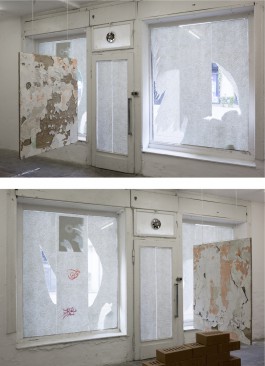
Décollage
A wooden board with detached wall surfaces on opposite sides of the corresponding walls. The opposite walls thus come together on the board, with their inner backs now facing outwards, creating a space for reflection on the conditions and conditioning of the room.
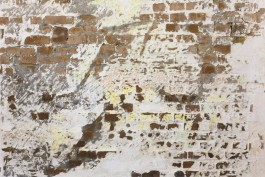
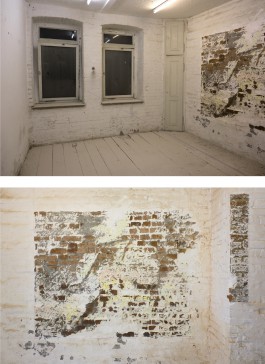
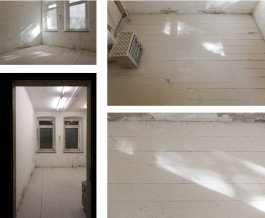
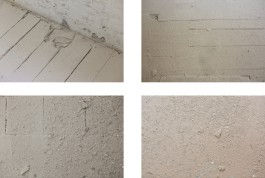
A partially sanded wall, whose dust settled on the floor and became a mark for every step one took on it.
The Broken Window
Group exhibition at the ‘Zuständige Behörde’ Leipzig, October 2015
With: Nico Curian, Francis Nicholson
As a collective, we dealt with various questions of space, which are specified by the site-specificity on the one hand and the site's connection to urban historical and structural conditions on the other.
At the specific location, Kuhturmstraße 4, which houses the art space ‘Zuständige Behörde’, processes that take place in and around the building were observed, facilitated, amplified and artistically processed over a period of three months. We paid particular attention to the specific history of the location and placed it in critical relation to our artistic work.
About the History of the Location
"Just one month after the opening of Lützner Straße 30 – home to the media art off-space ‘AundV’ until 2013 – the second Wächterhaus (guard house) of Haushalten e.V. opened in June at Kuhturmstraße 4. At the same time, Sebastian Helms, Denis Luce, Inga Martel and Stefan Riebel founded one of Leipzig's first project spaces here, the ‘Kuhturm’, where the first vernissage took place on 15 July 2005 in the building's shop. Installations by students from the Academy of Fine Arts Leipzig were on display. As early as winter 2006/07, the ‘dismissal’, the sale to a private investor, was prepared and quickly carried out. However, the shop remained in student hands and remains so to this day. Since 2013, the project space – now under the name ‘Zuständige Behörde’ – has been part of the ‘Institut für alles Mögliche’.
Its history shows processes of urban development ranging from alternative uses of vacant buildings through housing projects and art spaces to privatisation, renovation and rental. For the west of Leipzig, these processes are nothing new and can be described using the overused term gentrification. For us, this raises the question of what role culture and art, especially alternative forms, play in this process. According to the general discourse on gentrification, it is artists in particular who, due to favourable circumstances, occupy the space and enhance it through cultural activities. This is accompanied by socio-cultural and real estate changes in the respective neighbourhood.
In order to encourage critical discussion and formulate a position based on this, we asked the location, its surroundings and processes to present themselves. We covered the exterior windows of the space, formerly a shop, with woodchip wallpaper as a projection surface. In doing so, we turned the interior into an inscrutable exterior that provokes insight, and the exterior into an association with an interior space. After some time, the first scratched holes and graffiti appeared. We allowed this process to run its course, which led to more extensive damage and graffiti. In sociology, this is described by the broken windows theory, which refers to the decline of an area due to unresolved destruction, which can lead to complete neglect. According to Baudrillard's essay on graffiti, ‘Kool Killer or The Revolt of Signs,’ graffiti can also be understood as criticism or rebellion against the established semiocracy, which opposes the consumer-oriented designation of public space. During this time, the jewellery shop next door was broken into twice, which correlates with the broken windows theory. Quod erat demonstrandum.
With this critical practice, we followed the self-image of the ‘Instituts für alles Mögliche,’ which sees itself primarily as a medium for institutional criticism of the mainly commodity-oriented marketing chains of the art market, as:
‘...an [organic] artistic attempt to find niches and implant a non-commercial programme into the commercial structure of urban space. It aims to formulate an idea, an offer, an attitude as to how artistic collaboration, learning and living can be shaped.’
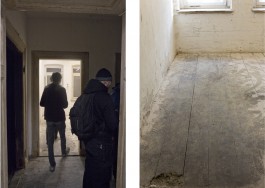
Inside the building, we also addressed the concept of renovation and its aesthetic implications. The woodchip wallpaper is one such element. According to non-functional use of the wallpaper, we removed and misappropriated other elements of a typical renovation, such as laminate flooring, plaster, lighting, cleaning, etc. All materials were taken from the building's inventory. The space was no longer to be a place for art that was ‘independent’ of it, but rather the subject of art itself. In this way, it provides insight into the various implications to which the place is subject. We were interested in finding an aesthetic that would arise from our engagement with this place. Together with the materials used, these are the aesthetics of imitation, cleaning vs. pollution, destruction, disclosure, etc. The result is a walk-in room installation whose design elements invite the viewer to reconnect them into different configurations and compositions. This has already been achieved by the curious holes from the outside, which create different lines of sight and thus open up the space and its contents in perspective.