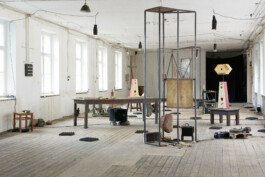
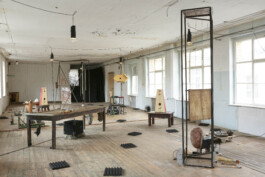
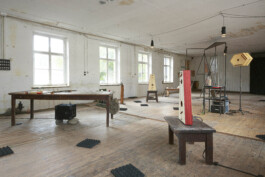
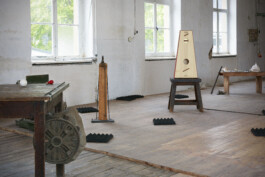
As part of the Mikroton Residency – in collaboration with the musician, sound artist and instrument maker Hendrik Herchenbach – a large-scale, site-specific sound and stage installation was created, featuring an electroacoustic composition made from samples recorded on site. On 12 June 26, our final concert performance took place in one of the rooms at the historic hp7 Arts and Crafts Centre (Hans-Poeche-Straße 7, Leipzig Zentrum-Ost).
During our residency, we sought direct engagement with the space of the historic site. We explored its architectural, historical and acoustic characteristics: we examined and listened to the building’s structure and the material qualities of the space, and investigated the wider inventory.
In doing so, we focused in particular on the historic precision engineering workshop Hammer – on its history of craftsmanship, its special affinity with materials, and the sonic implications of the respective machines, tools and products. We compiled an archive of recorded sound samples, which were woven together into a composition and served as a structuring prologue to the final sound performance.
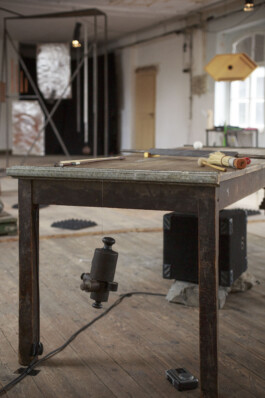
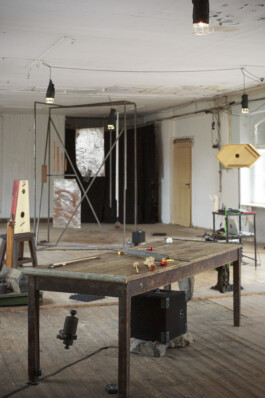
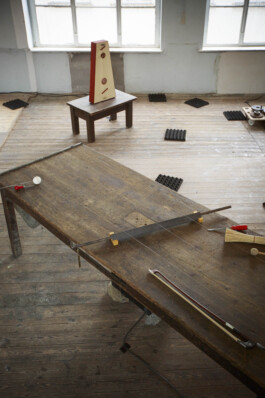
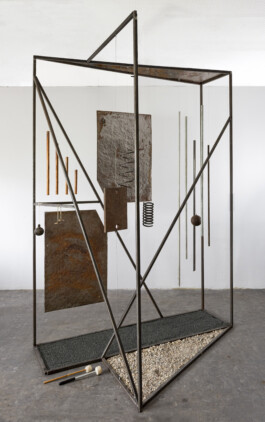
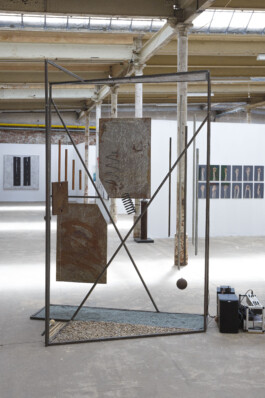
In the hall on the second floor, an arrangement of installation-based sound fields was created – site-specific adaptations of my modular sound space installations Ferrum and Tellurium. Carefully selected objects from the workshop’s inventory were integrated into the installation and the sound performance. The structure-borne sound of the installation and spatial elements was captured via pick-ups. Using Hendrik’s specially developed electro-acoustic resonators – a synthesis of musical instrument, loudspeaker and artistic object – the sound material arising from the performative interaction with the space and installation, as well as from the electronic composition, was translated and amplified. In this way, we sought to bring to life, through performative interactions, the reciprocal relationships, interpenetrations and ruptures between art and music theory and the history of craftsmanship and industry, using sound to create a kind of self-reflection on the material and historical conditions. Thus, through its direct contact with the space and its inventory, the performance also engaged with its concrete material and historical conditions.
A film recording of the performance is in preparation.
A big thank you to FOKUS Forum für künstlerische Umsetzung e.V. and hp_sieben e.V. for the invitation and their kind support throughout our stay!
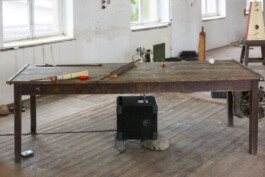
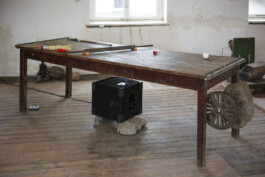
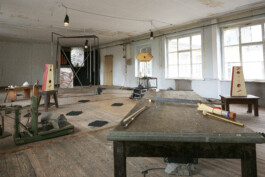
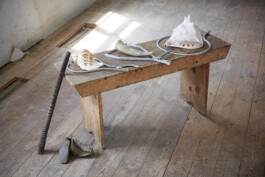
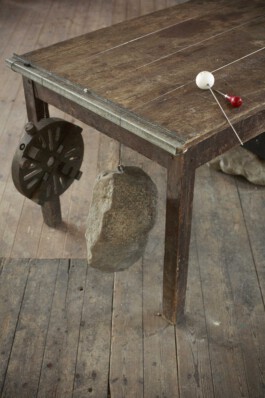
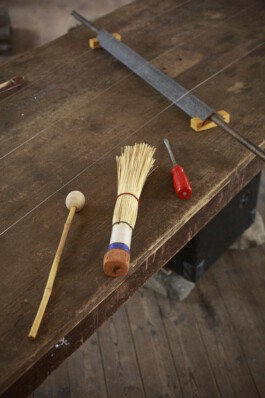
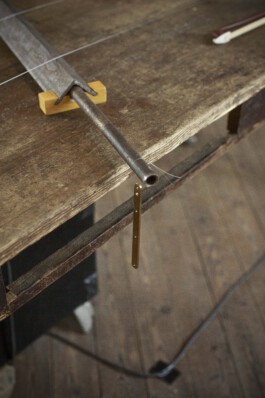
A central element of the installation and the performance is the Table, which originates from the collection of the historic workshops. Strung with piano wires – which were weighted down with weights, components from the precision workshop and boulders to tune them – and featuring a sliding bridge, the table installation was used by Hendrik and me in a performative, sound-based manner. In doing so, we performed gestures associated with various tasks, which had a mechanical effect on the table. The installation was fitted with a contact microphone and was acoustically amplified.
One source of inspiration and reference was a medieval woodcut illustrating Pythagoras’s musical experiments, which served as the basis for Western music theory. The founding myth, according to which Pythagoras arrived at his musical theory through a chance observation whilst experimenting with the monochord, points to an interesting intertwining of craftsmanship (in this case, the art of blacksmithing) and music theory. A similar association can also be found in the Torah, where the blacksmith Tubal and the forefather of music, Jubal, are half-brothers.
In my practice, I am interested in the material conditions and connections of cultural techniques and practices. For me, this work illustrates the physicality and materiality of sound, music and culture, which is otherwise often obscured. The weight of the tones.
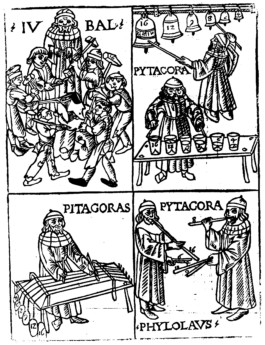
Woodcut showing Pythagoras with bells, a kind of glass harmonica, a monochord and (organ?) pipes in Pythagorean tuning. From Theorica musicae by Franchino Gaffurio, 1492 (1480?) Public Domain via Wikimedia Commons / Gallica Digital Library.
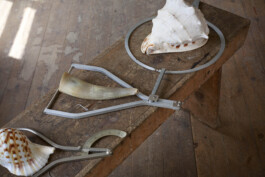
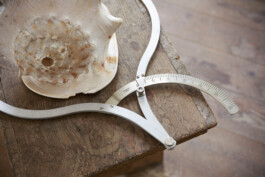
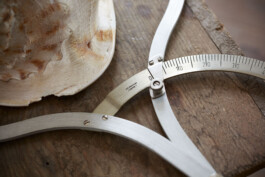
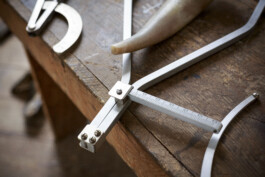
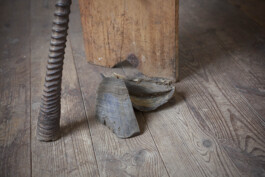
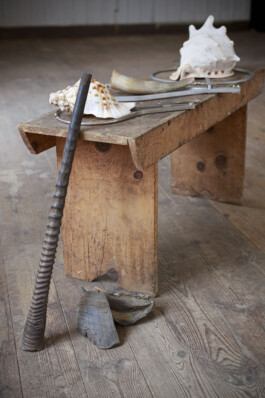
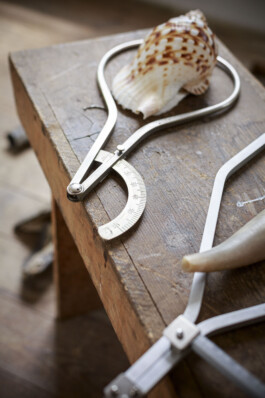
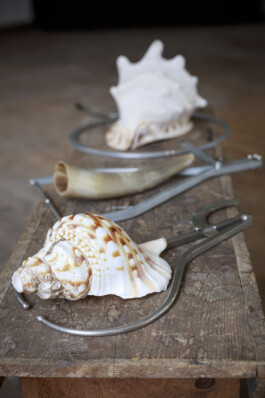
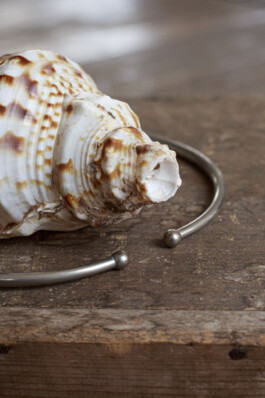
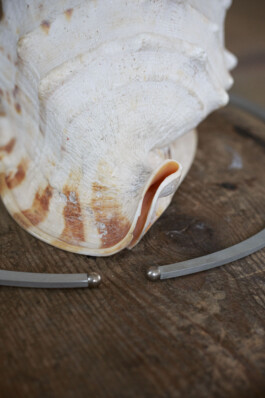
I was particularly drawn to the compasses and instruments produced by Hammer for the biometric measurement of animals. What fascinates me is the quantifying spirit that underlies the purpose of these instruments and characterises cultural achievement and labour in its use of nature and materials, their utilisation and transformation. Alongside these instruments, I found a severed hoof in another room of the workshop. Within the installation setting, I arranged the probes alongside the hoof and other animal horns from my own collection. In the concluding performance, this section of the installation and composition became a moment of intense articulation – ranging from breathing sounds through to rales and a rising cry, amplified and triggered by a cow’s horn – a sound of lament.
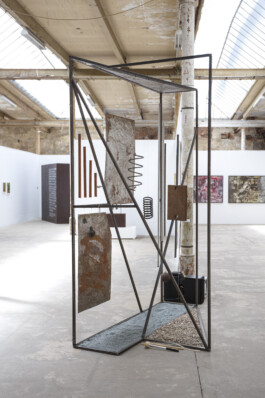
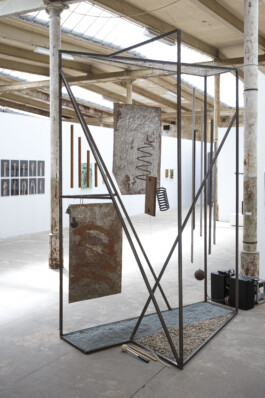
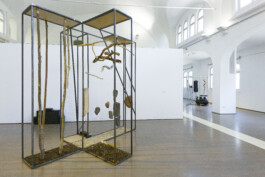

TELLURIUM 2.2
Presented as part of the exhibition: Resonating Bodies – Artistic Music Instruments, which runs from 22 June to 13 October 2024 at the Kunstmuseum Heidenheim.
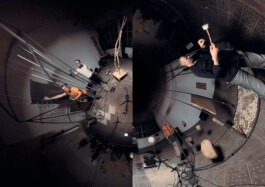
3D video of the musical performance by the group KALK (Hendrik Herchenbach, Torsten Pfeffer, Konrad Schreiter, Björn Werner) & Andreas Schröder.
Westwerk Leipzig, September 2022
Björn Werner – Tenor
Konrad Schreiter – Trumpet
Torsten Pfeffer – Percussion, Tellurium
Hendrik Herchenbach – Electric Bass, Synthesiser, Machines, Sound Collages, Tellurium
Funded by the Federal Government Commissioner for Culture and the Media in the NEUSTART KULTUR programme, Module D – Digital Communication Formats

Tellurium 2.0
Presented at the award winners' exhibition blind date at the plan.d. gallery in Düsseldorf.
Together with Kerstin Müller-Schiel.
Sound performance at the opening, 7 October 2020.
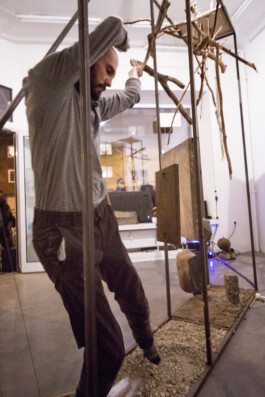
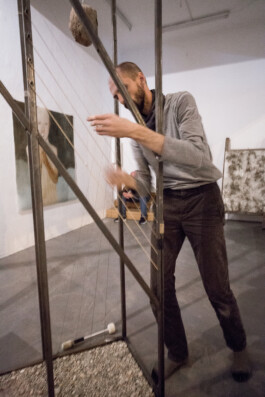
Sound Performance
Photos: Daniel Nehring
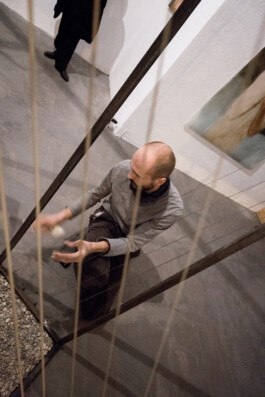
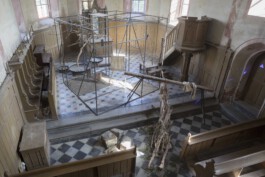
Tellurium 1.1 as part of the stage installation I developed for the musical theatre piece erdnah, a collaboration with composer Torsten Pfeffer, with the participation of Regina and Detlef Vitzthum. Premiered at the Großpötzschau Church in September 2020.
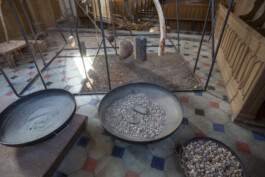
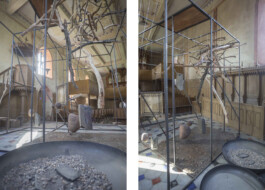
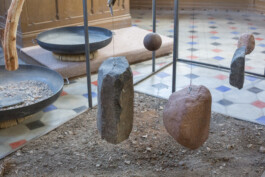
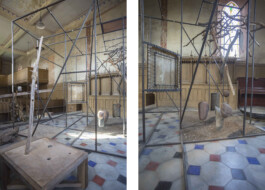
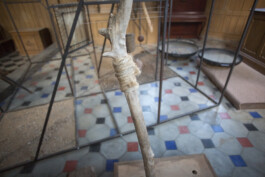
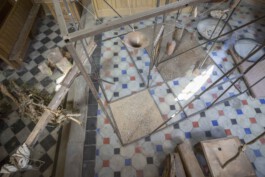
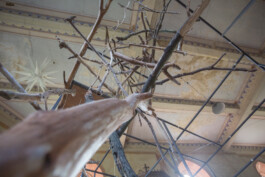
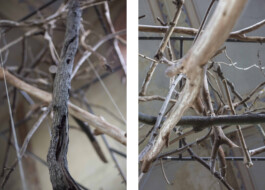
Views of the stage installation
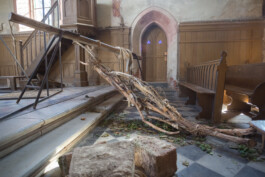
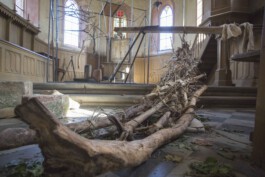
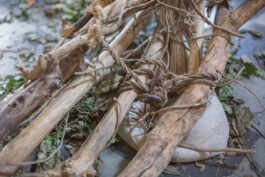
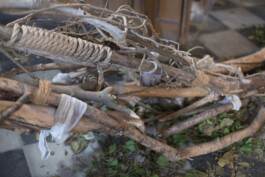
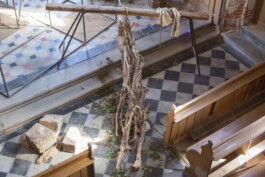
Corpus
Corpus is both a sculptural object and a theatre prop, consisting of various trunks and branches from dried-up or fallen trees. Held together by ropes, cloths and chains, it forms a fragile body that appears bound, chained, wounded or bandaged. It is attached to a beam between two trestles. It looks like a hunted animal or a sacrifice.
Corpus dramatically embodies some of the core themes of the play. At a central point in the play, it is dragged from the back of the church to the steps of the altar area, tied to the raised beam and bound with cloths. The scene oscillates between the brutality of a sacrifice and the care of a wounded person.
It is the body of nature that is drawn into the human drama, in which personal and interpersonal conflicts are played out and whose traces and wounds are inscribed. Caring for their wounds is caring for one's own. It is basically one wound. Only attentive care for the wound and encountering it creates space for healing and connection. This care for and encounter with the wound is sought through the means of art, in the choice of materials, their processing and performative handling.
Material: logs and branches, ropes, hooks, fabrics, cloths
Dimensions: approx. 350 x 60 x 70 cm

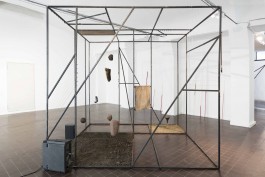
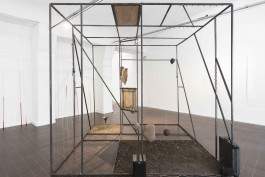
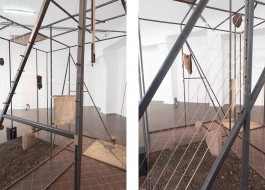
Tellurium 1.0
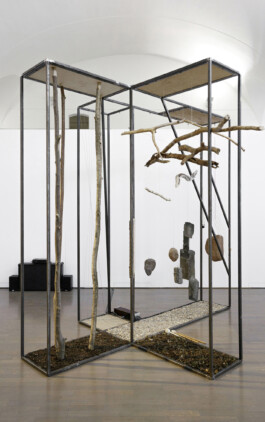
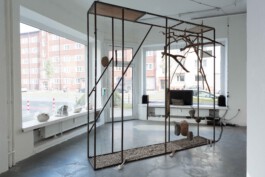
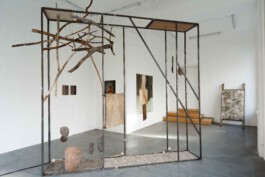
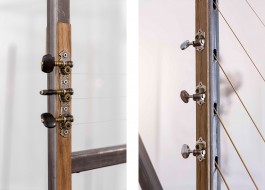
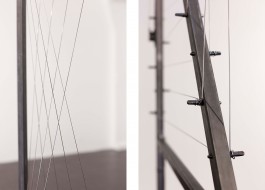
A walk-in installation for acoustic interactions. The installation consists of a metal structure (300x300x280cm) equipped with a rectangular drum made of goatskin, various piano and gut strings, some of which are attached to the floor with natural objects such as stones, wood, metal and earth. The entire structure is connected via piezo microphones to an audio system that makes the tensions and vibrations in the material audible when interacting with the elements of the structure.
Technical support by Peter Schröder.
Music performance by Torsten Pfeffer.
