
theatrum naturae et artium
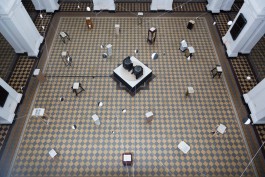
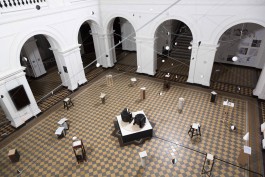
22 book pedestals and a rotating platform in the centre with two wind machines. The books cover topics ranging from materials science to scientific presentations on various premises (such as the contrasting views on optics held by Goethe and Newton), alchemical texts, various encyclopaedias, Borges' Library of Babel and the Chinese I Ching.

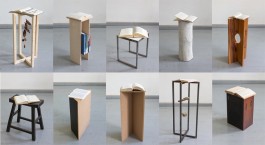

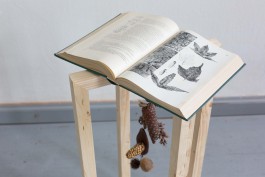
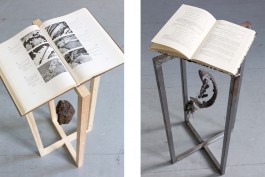
Typology of the book pedestals
Exhibition View
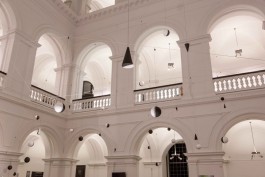

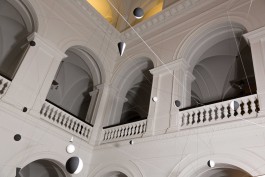
spatial notation
A network of steel wire with spherical and conical elements attached,
which served as spatial notation for a planned musical performance.
théâtre des petites perceptiones
Long Night of Science, 24 June 2016
Atrium of the Academy of Fine Arts Leipzig
Cooperation with Simon M. Osten & Hang Su
Kindly supported by the Friends of the Academy of Fine Arts Leipzig and the Cultural Office of the City of Leipzig.
On 24 June 2016, as part of the Long Night of Science and on the occasion of the Leibniz Year, the installation performance théâtre des petites perceptions took place in the atrium of the Academy of Fine Arts Leipzig. It consisted of three parts, each of which addressed certain aspects of Leibniz's philosophy in its own way and in correspondence with the others.
The floor installation theatrum naturae et artium by Andreas Schröder combined a stage with rotating wind machines and 23 pedestals distributed throughout the space with open books from a wide variety of fields of knowledge: scientific texts, alternative epistemologies, ironic commentaries on the thirst for knowledge, encyclopaedias, Pechmann's book on lost books, the taste thesaurus and the I Ching. They were alternately leafed through by wind from the stage fans located on the rotating platform in the centre of the room. Some pedestals were linked to things related to the contents of the books. Leibniz's educational ideal of synaesthetic knowledge transfer suggested liberating knowledge from its textual immateriality and linking it to its material correlate.
Above the books, Andreas Schröder's installation spatial notation extended up to the top floor: a network of intersecting wire ropes, with black and white spherical or conical elements attached at their intersections, functioned as a spatial notation. A musical performance conceived and performed by composer Hang Su interpreted the notation: the spherical and conical elements were read and played as notes in space. Three musicians moved through the atrium, oscillating between floors, navigating around the books and constantly finding new perspectives on the spatial notation. Through the fixed notation, which nevertheless allowed countless perspectives to be taken spatially, the performance explored some of Leibniz's philosophical concepts: the individual substances as represented in the doctrine of monads, and the relationship between freedom and necessity as expressed in pre-established harmony.
Music performance by: Johannes Cotta, Torsten Pfeffer, Hang Su
Video score for 3 screens by Hang Su

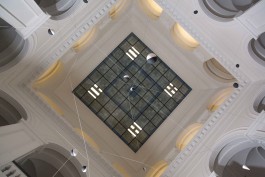
Ceiling
Design after the I-Ging by Simon M. Osten